Farm To Table Front Desk Growth Guides
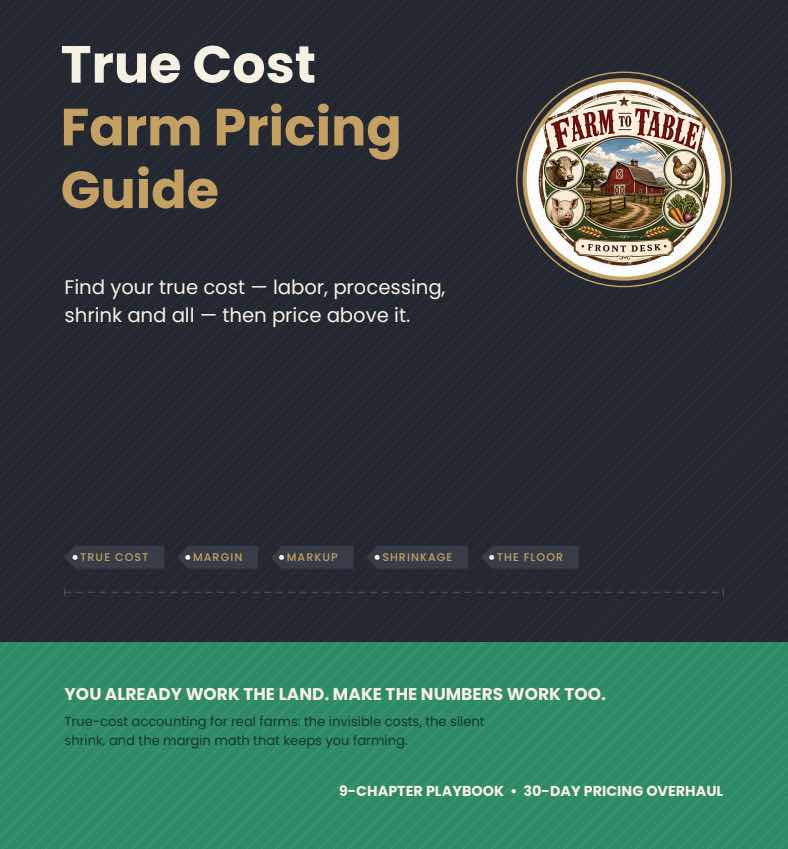
True Cost Farm Pricing Guide
True Cost Farm Pricing Guide
Couldn't load pickup availability
Know Your True Cost Before You Set a Single Price
Most farms unknowingly price products below what they actually cost to produce. The True Cost Farm Pricing Guide teaches you to calculate the complete cost of every product first, then build profitable pricing on top of it — no more guesswork.
It's easy to count feed, seed, or livestock and miss labor, processing, packaging, shrinkage, spoilage, delivery, transaction fees, equipment wear, and yield loss. Products that look profitable often earn almost nothing.
When you price against grocery stores or "what feels fair" instead of your real numbers, underpricing becomes chronic — you work harder every year and earn less.
Turn True Cost Into Profitable Prices
Using a structured framework, you calculate true cost per sellable unit, set profitable margin targets, and build sustainable pricing for every sales channel — then price confidently above your real cost.
The result is healthier margins, stronger cash flow, and a financially sustainable farm built on facts instead of assumptions.
What You'll Learn
- True-cost accounting — visible, invisible, and silent costs, worked all the way through
- Margin vs. markup — the confusion that quietly underprices farms
- Five pricing rules — cost first, wage in, shrink priced, rounded up
- The four-step price build — divide, don't multiply
- Shrinkage & yield — from mortality to freezer weight, price the loss in
- Price by channel — retail, wholesale, bundles, and the clearance floor
What's Inside the Guide
The Ledger Order
- Chapter 1 — Why Pricing Fails Farmers: the grocery anchor and the free-labor trap
- Chapter 2 — True-Cost Accounting: visible, invisible and silent costs — worked through
- Chapter 3 — Margin vs. Markup: the confusion that quietly underprices farms
- Chapter 4 — Five Pricing Rules: cost first, wage in, shrink priced, rounded up
- Chapter 5 — Building Your Price: the four-step method, divide-don't-multiply
- Chapter 6 — Shrinkage & Yield: mortality to freezer weight — price the loss in
- Chapter 7 — Price by Channel: retail, wholesale, bundles and the clearance floor
- Chapter 8 — Pricing Pitfalls: five ways farms give the profit away
- Chapter 9 — Measure & Scale: product P&L, price tests, break-even day
- 30-Day Pricing Overhaul: your week-by-week checklist
How to use this guide: Chapters 1–3 rebuild how you see your costs. Chapters 4–6 turn true cost into a price with real margin, chapter 7 adapts it per channel, and the 30-day overhaul reprices your whole product list — profitably, and without apology.
Frequently Asked Questions
What is true cost pricing for farms?
True cost pricing is a pricing method that calculates every cost involved in producing a farm product — including labor, processing, packaging, delivery, shrinkage, overhead, and spoilage — before setting a selling price. This guide teaches farmers how to calculate true cost first and then build profitable pricing above it.
How do I calculate the true cost of producing farm products?
Start by adding every visible cost, invisible cost, and hidden loss associated with production. The guide explains how to account for feed, fuel, labor, packaging, processing, delivery, market fees, spoilage, mortality, and equipment depreciation to determine the true cost per product.
Is there a farm pricing calculator included?
Rather than relying on a fixed calculator, this guide teaches a repeatable pricing system that lets farmers calculate true cost per product, select a target margin, and build profitable prices using their own financial data.
What is a farm pricing calculator?
A farm pricing calculator is a tool or method for turning your true cost per unit and a target margin into a selling price. This guide teaches a repeatable calculation you can run on your own numbers rather than relying on a one-size-fits-all calculator.
What is agricultural cost accounting?
Agricultural cost accounting is the process of tracking every expense associated with producing farm products. This guide breaks those costs into visible costs, invisible costs, and hidden shrinkage so farmers understand what each product actually costs to produce.
How can I improve farm profit margins?
Improving farm profit margins starts by understanding true production costs. The guide explains how pricing below true cost quietly destroys profits and shows how to establish pricing that protects healthy margins across every product.
How do I calculate farm profit margins?
Subtract your true cost per unit from the selling price, then divide by the selling price to get margin as a percentage. The guide shows how to set a target margin first and price up from true cost.
How should I price farm products?
Use a four-step process: calculate true cost, choose a target profit margin, price using the correct margin formula, and round prices appropriately while reviewing them regularly. This method replaces guesswork with consistent pricing decisions.
What is the cost of production for farm products?
Cost of production includes every expense required to produce and sell a product — not just feed or seed. Labor, processing, delivery, spoilage, shrinkage, market fees, packaging, and overhead all contribute to the true cost of production.
What is the best farm pricing strategy?
Price from true cost rather than competitor pricing. Calculate actual costs first, then select target margins, account for shrinkage, and review pricing quarterly to remain profitable.
How do I calculate livestock production costs?
Livestock pricing should include feed, veterinary costs, labor, processing, mortality, yield loss, packaging, delivery, and overhead. The guide explains why pricing only feed costs significantly underestimates the real cost of raising livestock.
How do I calculate meat pricing per pound?
Meat pricing should be based on packaged pounds rather than live weight. Processing yield, trim loss, shrinkage, and production costs must all be included before determining a profitable price per pound.
What is a meat pricing calculator?
A meat pricing calculator turns processing yield, trim loss, shrinkage, and production costs into a profitable price per packaged pound. The guide teaches this calculation on sellable weight, not live weight.
What is food cost analysis for farms?
Food cost analysis measures the complete cost of producing each product before determining selling price. The guide demonstrates how hidden costs can dramatically reduce profitability if they aren't included in pricing.
How does farm financial planning improve profitability?
Better pricing leads directly to stronger farm financial planning. The guide recommends quarterly cost reviews, annual pricing updates, product profitability analysis, and break-even tracking to improve long-term financial health.
Why is farm profitability so difficult?
Many farms unknowingly underprice products by comparing themselves to grocery stores or competitors instead of calculating true production costs. The guide explains how proper accounting and pricing create sustainable profitability.
How should farmers price agricultural products?
Agricultural products should be priced using actual production costs, target margins, and channel-specific pricing. The guide explains different pricing strategies for retail, wholesale, subscriptions, and clearance inventory.
How do I calculate true cost before pricing?
Track labor, production costs, processing, delivery, packaging, shrinkage, and overhead for every product. Once total cost is known, calculate selling prices using target margin formulas rather than guessing.
What is the difference between margin and markup?
Margin measures the percentage of the selling price that remains after costs, while markup measures how much was added to cost. The guide explains why confusing these two calculations is one of the biggest pricing mistakes farmers make.
How should shrinkage be included in pricing?
Shrinkage — including spoilage, mortality, processing loss, giveaways, and unsold inventory — must be included in every product's cost calculation. The guide shows how pricing shrinkage into products protects long-term profitability.
How does bookkeeping improve farm pricing?
Accurate bookkeeping provides the data needed to calculate true production costs. The guide recommends regularly reviewing expenses, tracking labor, updating cost sheets, and measuring product profitability throughout the year.
How do I calculate cost per pound?
Cost per pound should be based on sellable packaged weight after processing losses, not live weight. The guide explains how yield affects profitability and why packaged weight is the correct basis for pricing meat products.
How do I stop underpricing farm products?
Stop comparing to grocery stores and start pricing from true cost. Calculate every visible, invisible, and hidden cost, add a target margin, price shrinkage in, and review your prices quarterly.
How can I build a more profitable farm business?
Profitable farms know their numbers. This guide teaches farmers how to calculate true production costs, establish healthy margins, review pricing quarterly, eliminate pricing mistakes, and make better financial decisions for long-term success.
Pairs with