Farm To Table Front Desk Growth Guides
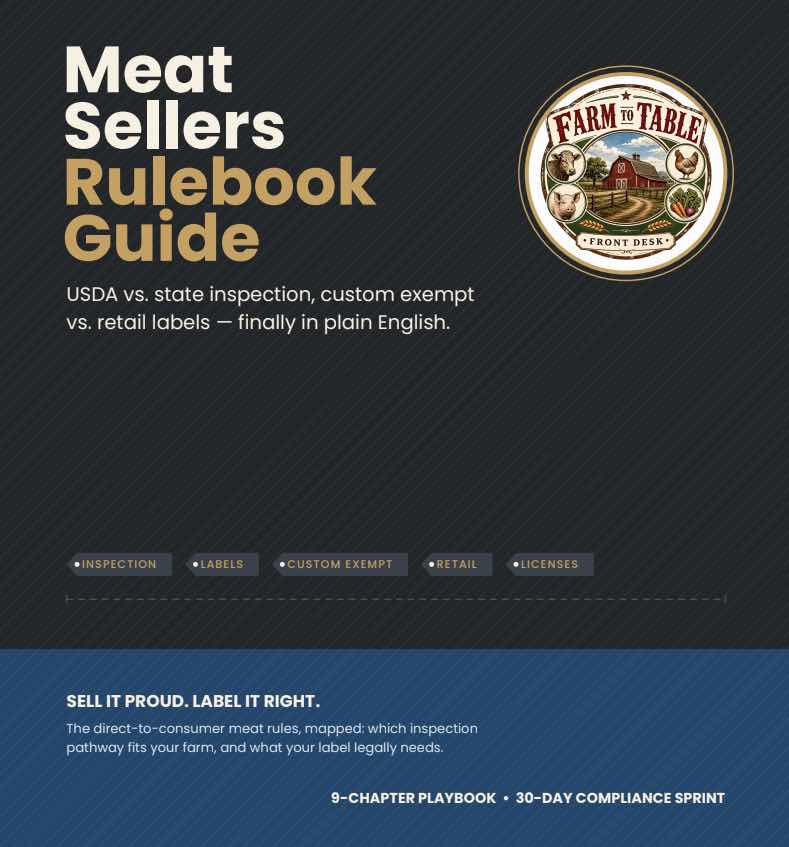
Meat Sellers Rulebook Guide
Meat Sellers Rulebook Guide
Couldn't load pickup availability
Sell Meat Directly — Legally, Confidently, Without the Guesswork
Direct-to-consumer meat is one of the most profitable moves a farm can make — and one of the easiest to get wrong. The Meat Sellers Rulebook Guide maps every inspection pathway and labeling rule in plain English so you know exactly what you can sell, where, and how.
USDA inspection, state inspection, custom exempt processing, animal-share agreements, retail labels — the rules are confusing, and mistakes get expensive. This guide turns that confusion into a clear compliance roadmap.
Stop guessing at regulations. Start selling with confidence.
What the Meat Sellers Rulebook Guide Solves
Uncertainty about inspection status, legal labels, licensing, and approved sales channels creates real risk: rejected products, lost sales, and regulatory violations.
This guide translates USDA and state meat regulations into practical, farmer-friendly steps so you can expand your selling options while staying compliant.
What You'll Learn
- Choose the right inspection pathway — USDA vs. state inspection vs. custom exempt, mapped to how you want to sell
- Run animal-share sales correctly — transfer ownership before slaughter with proper documentation
- Build compliant retail meat labels — every element an inspected label legally needs
- Handle marketing claims — what "grass-fed," "organic," and "natural" require before they hit a label
- Sell through the right channels — farmers markets, farm stores, online, and wholesale, each with its own rules
- Avoid the classic compliance mistakes — the pitfalls that end farm meat businesses
What's Inside the Guide
The Rule Order
- Chapter 1 — Why the Rules Matter: one right setup beats years of gray areas
- Chapter 2 — The Inspection Ladder: federal, state, custom exempt — mapped
- Chapter 3 — The Animal-Share Model: custom exempt, done exactly right
- Chapter 4 — Retail Labels 101: every element an inspected label needs
- Chapter 5 — Claims & Buzzwords: "grass-fed," "organic" and what needs approval
- Chapter 6 — The Paper Trail: licenses, permits and records beyond inspection
- Chapter 7 — Channels & Their Rules: market, farm store, online, wholesale
- Chapter 8 — The Five Classic Pitfalls: the mistakes that end farm meat businesses
- Chapter 9 — Work With Your Regulators: turn inspectors into allies
- 30-Day Compliance Sprint: your week-by-week checklist
How to use this guide: Chapter 2 helps you pick your pathway — read it twice. Chapters 3–6 build your labels and paperwork, 7–9 keep you clean in the real world, and the sprint at the back turns it into one month of calls and checklists.
This guide is an educational resource, not legal advice. Regulations vary by state — always confirm requirements with USDA FSIS and your state department of agriculture before selling.
Frequently Asked Questions
What is USDA meat inspection?
USDA meat inspection is the federal inspection pathway that allows farms and processors to sell inspected meat across state lines. The guide explains how USDA inspection differs from state inspection and custom exempt processing, and how each pathway affects where and how you can legally sell meat.
What is the difference between USDA and state meat inspection?
USDA inspection allows meat sales nationwide, while state inspection generally allows sales within the state. Some state-inspected facilities may qualify for interstate sales through the Cooperative Interstate Shipment (CIS) program.
What is custom exempt meat?
Custom exempt meat is processed for the animal's owner rather than sold at retail. Packages are marked "NOT FOR SALE," and ownership of the animal must transfer before slaughter through an animal-share agreement.
Can I legally sell custom exempt meat?
Custom exempt meat cannot be sold by the package or individual cut. Instead, farms sell ownership shares in a live animal before processing, with documentation proving ownership.
What is the animal share program?
An animal-share program allows customers to purchase ownership in a live animal before slaughter. Ownership must transfer before processing, pricing is based on the animal rather than packaged cuts, and every owner must have documented paperwork.
What are meat labeling requirements?
Inspected retail meat labels typically include the product name, inspection legend and establishment number, net weight, safe handling instructions, business information, and ingredient statements when applicable. Each element serves a legal compliance purpose.
What is required on USDA meat labels?
USDA-inspected labels generally include the inspection legend, establishment number, product name, accurate net weight, safe handling instructions, and required business identification.
What is the difference between retail meat labels and custom exempt labels?
Inspected retail products use approved retail labels, while custom exempt packages are marked "NOT FOR SALE" and are intended only for the animal's owners — not retail sales.
Can I sell meat directly to consumers?
Yes, but your legal sales options depend on your inspection pathway. USDA inspection, state inspection, and custom exempt processing each have different rules for direct-to-consumer sales.
Can I sell meat at farmers markets?
Inspected meat with proper retail labels may be sold at farmers markets when required licenses, permits, and compliant frozen storage are in place. Custom exempt meat is not intended for retail market sales.
Can I sell meat online?
Shipping meat across state lines generally requires USDA-inspected product or another qualifying inspection pathway. Online orders should also meet labeling and shipping requirements.
Can I wholesale meat to restaurants or grocery stores?
Wholesale buyers generally purchase inspected products that meet applicable labeling requirements. Inspection status and approved labels help support wholesale transactions.
What licenses do I need to sell meat?
Common requirements include retail food licenses, frozen storage approvals, certified scales, vendor permits, liability insurance, and sales records. Requirements vary by location.
What is USDA FSIS?
USDA FSIS is the Food Safety and Inspection Service, the federal agency for meat inspection questions. The guide recommends contacting FSIS resources for federal inspection questions and confirming requirements before selling.
Should I contact my state department of agriculture?
Yes. Confirm your inspection pathway, labeling requirements, and applicable licenses with your state department of agriculture before beginning sales, because regulations vary by state.
What marketing claims require label approval?
Claims such as organic, grass-fed, raised without antibiotics, and natural often require label approval. Many marketing claims require documentation or approval before appearing on inspected meat labels.
What are the most common meat compliance mistakes?
The most common mistakes are selling custom exempt meat as retail, missing label information, incorrect share agreements, unsupported marketing claims, and expanding into new sales channels without confirming requirements. Avoiding these helps farms stay within their inspection pathway.
What is a meat compliance guide?
A meat compliance guide is a plain-English roadmap covering inspection pathways, labeling, licensing, sales channels, paperwork, and a 30-day compliance checklist designed to help farms understand common regulatory frameworks before selling meat.
How do I know which meat inspection pathway I need?
Your inspection pathway determines where you can sell, how your products must be labeled, and which sales channels are available. The guide compares three primary pathways: USDA inspection, state inspection, and custom exempt processing.
Does this guide include a compliance checklist?
Yes. The guide concludes with a 30-day compliance sprint covering inspection, labeling, processor verification, licensing, paperwork, and recordkeeping to help farms organize their compliance efforts.
Pairs with