Farm To Table Front Desk Growth Guides
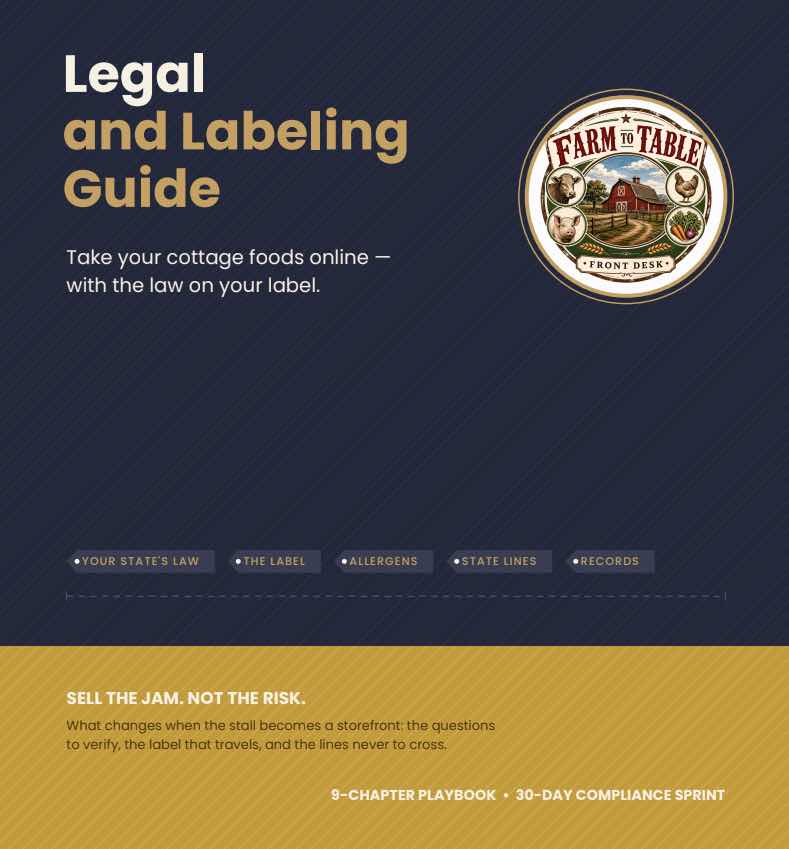
Legal and Labeling Guide
Legal and Labeling Guide
Couldn't load pickup availability
Sell Cottage Foods Online — Legally and Confidently
Taking your jams, baked goods, and shelf-stable products online adds a whole new layer of legal, labeling, shipping, and compliance requirements. The Legal and Labeling Guide gives cottage food producers a step-by-step system for selling online while staying inside their state's rules.
Every state has different cottage food laws — what you can sell, where, how to label it, whether online ordering and shipping are allowed, and when you outgrow cottage food status.
Get it wrong and you risk rejected listings, payment-platform issues, and regulatory violations. This guide teaches you exactly what to verify.
Compliance Is a Feature, Not a Chore
Instead of outdated advice or generic templates, you'll learn how to verify your state's regulations, determine which products and channels are permitted, build compliant labels, disclose allergens correctly, configure your online storefront, avoid prohibited health claims, and keep clean records.
The result is an online food business that protects your customers and your brand — and stays compliant as regulations change.
What You'll Learn
- Know your lane — allowed food lists, sales channels, sales caps, and permits
- Five compliance rules — verify, label, no claims, hard walls, records
- The compliant label — identity, ingredients, allergens, and state disclosure
- Online storefront rules — listings that carry the label with them
- Marketing without tripwires — honest photos, filtered claims, platform rules
- Stay current & scale — annual checks, cap tracking, and going commercial
What's Inside the Guide
The Fine-Print Order
- Chapter 1 — Compliance Is a Feature: the trust asset hiding in the fine print
- Chapter 2 — The Stall-to-Screen Shift: what changes online — and who answers
- Chapter 3 — Know Your Lane: allowed lists, channels, caps and permits
- Chapter 4 — Five Compliance Rules: verify, label, no claims, hard walls, records
- Chapter 5 — Build the Compliant Label: identity, ingredients, allergens, disclosure
- Chapter 6 — The Online Storefront Rules: listings that carry the label with them
- Chapter 7 — Marketing Without Tripwires: honest photos, filtered claims, platform rules
- Chapter 8 — Compliance Pitfalls: five quiet mistakes that get sellers shut down
- Chapter 9 — Stay Current & Scale: annual checks, cap tracking, going commercial
- 30-Day Compliance Sprint: your week-by-week checklist
How to use this guide: Cottage food law is state law — it varies enormously and changes often, so this guide teaches you WHAT to verify and HOW to build compliant habits, never what's legal in your zip code. Chapter 2's question list is the spine; your state's own rules are always the final word.
This guide is an educational resource, not legal advice. Cottage food laws vary by state and change frequently — always confirm current requirements with your state's cottage food program before selling.
Frequently Asked Questions
What are cottage food laws?
Cottage food laws allow people to prepare and sell certain homemade foods from a home kitchen. Every state has different rules covering approved products, labeling, sales channels, annual sales limits, and registration requirements. This guide explains what to verify before selling online.
Can I sell cottage foods online?
Many states allow some form of online ordering, but each state has different rules for websites, payment processing, pickup, delivery, and shipping. This guide shows you the seven questions every seller should ask before opening an online store.
What information must appear on a cottage food label?
A compliant cottage food label generally includes the product name, business information, ingredient list, allergen declarations, net weight, and your state's required disclosure statement. The guide explains how to build a complete compliant label.
What are cottage food labeling requirements?
Every state has different labeling requirements, but this guide teaches a four-part labeling system covering product identity, ingredients, allergen declarations, and state-required disclosures so sellers know exactly what to verify.
How do I start a cottage food business?
Begin by verifying your state's approved food list, permitted sales channels, annual sales limits, required registrations, and labeling rules before selling your first product online.
Can I ship homemade food to another state?
Interstate shipping often falls outside state cottage food laws. Verify shipping permissions directly with your state's cottage food program before accepting orders.
What foods qualify under cottage food regulations?
Many cottage food laws cover shelf-stable products such as baked goods, jams, candies, dry mixes, and similar products. The exact list varies by state, so verify approved foods before selling.
What allergens must be listed on food labels?
Allergen labeling identifies major food allergens whenever they're present. Allergen information should appear both on product packaging and on your online product pages.
How do I sell homemade food online legally?
Selling legally requires verifying state regulations, building compliant labels, configuring online checkout correctly, limiting delivery to approved sales channels, maintaining records, and reviewing regulations annually. The guide walks sellers through each step.
Can I sell homemade food on Shopify?
You can use Shopify or another platform, but you must configure it to match your state's cottage food rules — approved products, permitted sales channels, correct labeling on listings, and delivery limited to allowed areas. The guide covers online storefront compliance.
How do I prepare for online food sales?
Verify your state's approved foods and sales channels, build compliant labels, mirror that label information on your product pages, limit delivery to permitted areas, and set up recordkeeping before you launch.
Do online food product pages need labeling information?
Yes. Online product listings should mirror the information found on the physical product label so buyers can review ingredients, allergens, and required disclosures before purchasing.
What are common cottage food compliance mistakes?
Common mistakes include shipping outside approved areas, copying another state's label, making health claims, exceeding annual sales limits, and failing to maintain compliance records.
Can I make health claims about homemade food?
Avoid medical or health claims in product descriptions and marketing materials. Food should be marketed as food, not as medicine.
How do I create compliant food packaging?
Use a four-block label system: product identity, ingredient listing, allergen declarations, and state-required disclosures. Labels should be clear, readable, and accurate.
How do I stay compliant with cottage food regulations?
Verify your state's rules, build compliant labels, avoid health claims, keep sales within approved channels and limits, maintain records, and run an annual review. The guide turns these into repeatable compliance habits.
What records should a cottage food business keep?
Maintain written records of state guidance, registrations, labels, sales totals, ingredient changes, and annual compliance reviews to simplify inspections and business growth.
How often should I review cottage food regulations?
Because state regulations change frequently, perform an annual compliance review that includes checking regulations, updating labels, reviewing listings, and verifying sales limits.
How do I grow beyond cottage food laws?
Monitor your annual sales limits and prepare to transition into commercial food production once demand exceeds cottage food regulations.
What is a cottage food compliance guide?
A cottage food compliance guide is a plain-English roadmap for selling homemade food legally, covering approved products, labeling, allergens, online storefront rules, shipping, marketing, and recordkeeping. This guide teaches what to verify with your state.
What does this Legal & Labeling Guide include?
This guide includes a cottage food compliance checklist, labeling system, allergen labeling guidance, online storefront compliance, shipping considerations, marketing compliance, a recordkeeping system, an annual compliance review, and a 30-day implementation plan — all designed to help home food businesses sell with confidence while staying within their state's rules.
Pairs with