Farm To Table Front Desk Growth Guides
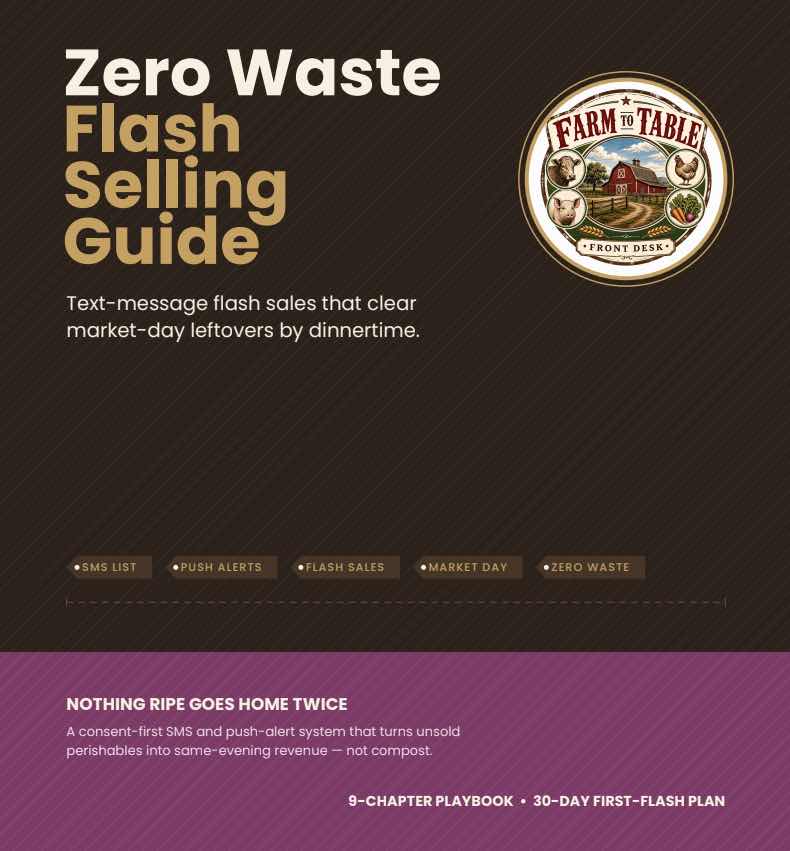
Zero Waste Flash Selling Guide
Zero Waste Flash Selling Guide
Couldn't load pickup availability
Turn Market-Day Leftovers Into Tonight's Sales
Stop composting your profits. The Zero Waste Flash Selling Guide is a proven SMS system that helps farms sell unsold market inventory the same evening — before it loses value.
Every market day ends the same way: the crowds leave, but fresh produce, baked goods, meat, eggs, and flowers don't. By morning, that inventory is discounted, degraded, or gone to waste.
This guide fixes the 4 p.m. problem with one consent-based text message — not another social post buried by the algorithm.
How the Zero Waste Flash Selling System Works
Instead of hoping customers come back, you send a single flash sale text to subscribers the moment market closes. It announces your true surplus, limited quantities, special pricing, and a same-evening pickup window.
Customers see it within minutes, claim products with one tap or a quick reply, pay before pickup, and collect fresh product that night. Surplus becomes revenue — not compost.
What This Sustainable Selling System Delivers
- Higher sell-through — move true surplus before it spoils
- Less food waste — rescue fresh product and support zero waste farming goals
- Faster cash flow — same-day revenue from inventory you already grew
- Stronger loyalty — an owned SMS customer list that belongs to your farm, not a platform
- A repeatable rhythm — a weekly flash sale strategy you can run in under an hour
What's Inside the Guide
The Selling Order
- Chapter 1 — Why Flash Sales: the 4 p.m. problem every market farmer knows
- Chapter 2 — The List Is the Business: building a text list the legal, welcome way
- Chapter 3 — Choose Your Channel: SMS, push, email, stories — ranked by speed
- Chapter 4 — The Flash Sale Formula: five rules that sell out every drop
- Chapter 5 — Messages That Move: write the text that empties the cooler
- Chapter 6 — Pickup & Payment: hand-offs that take minutes, not evenings
- Chapter 7 — The Market-Day Rhythm: your hour-by-hour flash routine
- Chapter 8 — Grow the List: signage, QR codes and referrals that compound
- Chapter 9 — Measure & Scale: sell-through math and what to tune next
- 30-Day First-Flash Plan: your week-by-week checklist
How to use this guide: Chapters 1–3 build your list and pick your channel — do these before your next market. Chapters 4–6 are the sale itself. Chapters 7–9 make it a weekly habit, and the 30-day plan puts it all on one page.
Built for farmers market vendors and any zero waste business ready to turn surplus into steady, sustainable income.
Frequently Asked Questions
What is zero-waste selling for farms?
Zero-waste selling is a marketing system that helps farms sell market-day leftovers before they spoil. This guide teaches farmers how to use consent-based SMS marketing, flash sales, and customer alerts to turn surplus produce into same-evening revenue instead of food waste.
How can farmers reduce food waste?
Create a customer text message list and send flash sale alerts immediately after market closes whenever surplus inventory is available. Customers receive a limited-time offer while produce is still fresh, helping farms reduce waste and recover revenue.
How do I sell leftover produce after the farmers market?
Count remaining inventory after market, send one short SMS flash sale to customers who opted in, collect orders quickly, and complete pickup the same evening. This turns unsold produce into same-day sales.
What are farmers market leftovers?
Farmers market leftovers are fresh fruits, vegetables, meats, baked goods, eggs, and other products that remain unsold at the end of a market day. This guide focuses on turning those leftovers into additional sales instead of compost.
What is farm SMS marketing?
Farm SMS marketing uses text messages to communicate directly with customers who have requested updates. The guide focuses specifically on consent-first SMS flash sales for surplus inventory, rather than frequent promotional messaging.
Why should farms use text message marketing?
Text messages are typically read within minutes, making SMS the fastest way to notify customers about limited quantities of fresh products before they expire. Speed is what makes a flash sale strategy work.
What is a flash sale for farms?
A farm flash sale is a short, limited-time offer sent after market day advertising surplus products at a discounted price for pickup within a few hours. The guide recommends keeping flash sales limited to true surplus so regular pricing stays protected.
How do flash sales reduce produce waste?
They sell fresh inventory before it can spoil. Instead of letting product degrade, you notify loyal customers immediately after market closes with accurate quantities, pickup times, and pricing so surplus sells the same day.
How do I build a farm customer list?
Collect customer consent at the farmers market using QR codes, signage, and simple signup forms. Every customer must voluntarily opt in before receiving marketing text messages.
Why is consent important for farm SMS marketing?
Text marketing should always be permission-based. Customers should clearly understand what messages they'll receive, how often they'll receive them, and how to opt out at any time.
How often should farms send text alerts?
Send text alerts only when genuine surplus inventory is available. For many farms, this means roughly one flash sale per week during market season rather than daily promotional messages.
How do I sell fresh produce today?
Count remaining inventory immediately after market closes, prepare one concise SMS with product details, pricing, and pickup instructions, then send it within the hour while produce is still fresh.
What should a farm flash sale text message include?
A farm flash sale text should include four elements: your farm name, the exact product and quantity, the pickup deadline, and one simple action to order. Keeping the message short improves response rates.
How do farms manage surplus inventory?
Quickly count remaining products after every market, identify true surplus, and offer only those items through flash sales while keeping regular pricing for normal inventory.
How do I improve direct farm sales?
Build an owned customer list instead of relying entirely on social media. Direct SMS communication lets farms quickly sell available inventory whenever surplus exists.
Why is a farm customer list valuable?
Followers belong to social media platforms, but an SMS customer list belongs to the farm. Every new subscriber becomes a direct marketing asset that can generate repeat purchases over time.
Can farmers market vendors use flash sales?
Yes. This guide is designed specifically for farmers market vendors who regularly finish market day with unsold produce, meats, eggs, baked goods, or other perishable inventory.
How do I create same-day farm sales?
Follow a consistent weekly routine: count leftover inventory, send one SMS flash alert, collect orders, and complete pickup the same evening. This repeatable process converts surplus into same-day revenue.
What is market-day surplus?
Market-day surplus refers to quality products that remain after a farmers market closes. Instead of discounting everything throughout the day, the guide recommends offering surplus during a dedicated evening flash sale.
Does this guide help with farm inventory management?
Yes. It includes methods for counting surplus inventory, measuring sell-through rates, tracking time-to-sellout, and evaluating which products consistently create demand.
What metrics should farms track during flash sales?
Track five metrics: sell-through percentage, time to sell out, customer list growth, pounds of food rescued, and revenue generated from surplus. These help improve future flash sales while supporting zero-waste farming goals.
How do flash sales support zero-waste farming?
Every successful flash sale reduces compost, rescues fresh food, increases farm revenue, and strengthens customer relationships. The goal is to make sure fresh products reach customers instead of becoming waste.