Farm To Table Front Desk Growth Guides
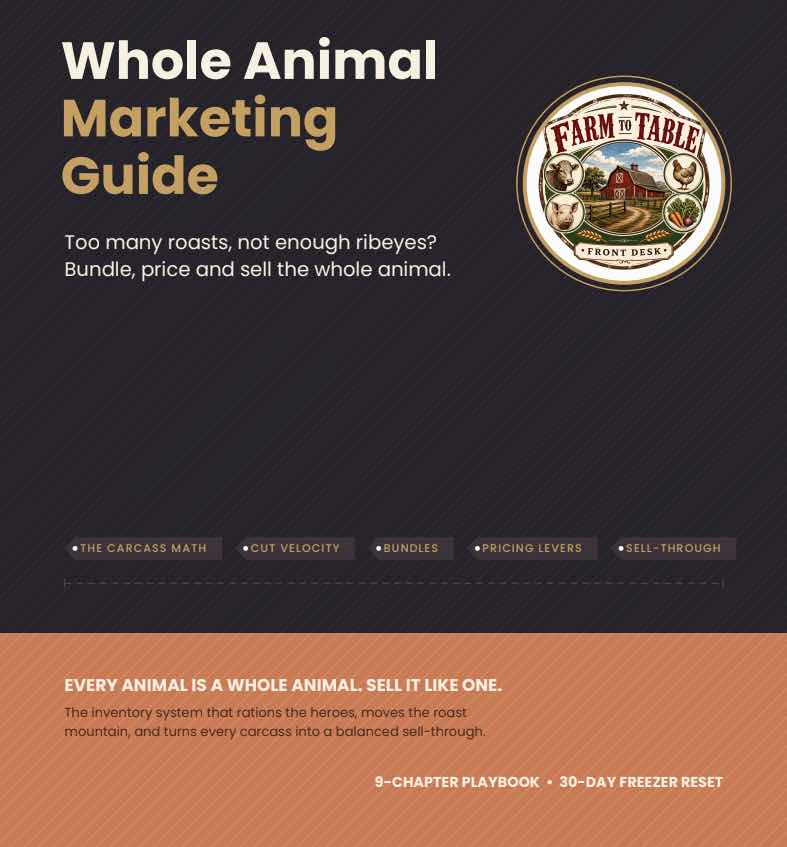
Whole Animal Marketing Guide
Whole Animal Marketing Guide
Couldn't load pickup availability
Sell Every Cut on Purpose — Not Just the Steaks
Ribeyes and ground beef fly out the door while chuck roasts, shanks, and soup bones pile up in the freezer. The Whole Animal Marketing Guide teaches you to sell each animal as one balanced inventory system instead of a collection of individual products.
Because every animal yields a fixed ratio of premium and value cuts, selling only the favorites creates an imbalance that ties up cash, raises freezer costs, and forces markdowns.
The fix isn't more sales — it's balance. This guide clears the roast mountain and keeps it clear.
A System That Sells Every Cut at Pace
Using cut-velocity tracking, strategic meat bundles, whole-animal pricing, recipe-driven marketing, subscriptions, and sell-through planning, you balance demand across every cut class.
Instead of selling out of steaks while slow cuts accumulate, you build predictable inventory turnover, healthier cash flow, and higher whole-animal margins — a freezer that sells on purpose.
What You'll Learn
- The inventory backbone — counts, par levels, and monthly velocity reads
- Five freezer rules — ration heroes, bundle the slow, FIFO forever
- The bundle machine — the box ladder that mirrors the animal
- Pricing the balance — five levers that move meat without panic
- Move the mountain — recipes, drops, subscriptions, and the chef valve
- Measure & scale — sell-through, the quality clock, and head counts
What's Inside the Guide
The Freezer Order
- Chapter 1 — Why Inventory: the problem isn't sales — it's balance
- Chapter 2 — The Carcass Problem: fixed ratios, velocity gaps, the freezer tax
- Chapter 3 — The Inventory Backbone: counts, par levels and monthly velocity reads
- Chapter 4 — Five Freezer Rules: ration heroes, bundle the slow, FIFO forever
- Chapter 5 — The Bundle Machine: the box ladder that mirrors the animal
- Chapter 6 — Pricing the Balance: five levers that move meat without panic
- Chapter 7 — Move the Mountain: recipes, drops, subscriptions and the chef valve
- Chapter 8 — Freezer Pitfalls: five ways the balance breaks
- Chapter 9 — Measure & Scale: sell-through, the quality clock, head counts
- The 30-Day Freezer Reset: count it, bundle it, systemize it
How to use this guide: Chapters 1–3 turn the freezer from a mystery into a counted, measured system. Chapters 4–7 build the bundles, prices and channels that sell every cut class at pace — and the 30-day reset clears the roast mountain you already have.
Frequently Asked Questions
What is meat inventory management?
Meat inventory management is the process of tracking every cut, monitoring inventory levels, measuring sell-through rates, and balancing customer demand so an entire animal sells profitably instead of leaving slow-moving cuts in the freezer. This guide teaches a complete whole-animal inventory system.
How do I sell a whole animal instead of just premium cuts?
Sell every animal through balanced meat bundles, pricing strategies, inventory tracking, recipe marketing, subscriptions, and targeted promotions so every cut sells at the proper pace.
How do I sell every cut from a beef animal?
Sell the whole animal as one system: ration premium cuts, bundle slower-moving ones, price across the entire carcass, and use recipes and subscriptions so every cut class moves at pace.
What is whole animal marketing?
Whole animal marketing is a strategy that markets every cut from an animal rather than focusing only on steaks or premium cuts. The guide teaches how bundles, recipes, subscriptions, chef sales, and pricing work together to improve whole carcass profitability.
What is whole carcass profitability?
Whole carcass profitability is the margin earned across every cut of an animal, not just the premium steaks. It improves when slower cuts sell at pace instead of aging in the freezer.
How can farms improve whole carcass profitability?
Farms improve profitability by balancing inventory, rationing premium cuts, bundling slower-moving cuts, pricing across the entire carcass, and increasing inventory sell-through instead of discounting excess inventory.
What is direct-to-consumer meat sales?
Direct-to-consumer meat sales allow farms to sell meat directly to customers through farm stores, Shopify websites, subscriptions, and meat bundles. Balanced inventory management increases profits from these sales channels.
How do meat bundles increase farm profits?
Rather than selling individual cuts separately, meat bundles combine premium and slower-moving cuts into curated boxes that improve inventory turnover while maintaining whole-animal margins. Every bundle should include at least one slower-moving cut.
What are the best meat bundle ideas?
Use a three-tier bundle system: a Starter Box, a Family Box, and a Freezer Fill Box. Each bundle mirrors the natural mix of the animal while appealing to different customer budgets.
How do you price meat bundles?
Bundle pricing should be slightly lower than purchasing every cut individually while still achieving whole-carcass profitability. Blend pricing across all cuts rather than maximizing margin on each individual package.
How do I market beef bundles?
Build a box ladder (Starter, Family, Freezer Fill) that mirrors the animal, price bundles slightly below buying every cut separately, and pair them with recipes so customers know how to use every cut.
What is freezer inventory management?
Freezer inventory management means counting every cut, tracking inventory in Shopify, measuring monthly velocity, rotating inventory using first-in-first-out (FIFO), and monitoring sell-through by cut class.
How do I balance meat inventory?
Count every cut, set par levels, read monthly velocity, ration fast-moving heroes, bundle slow movers, and rotate with FIFO so the whole freezer sells on purpose.
What is freezer turnover?
Freezer turnover measures how quickly inventory sells before aging. Track days-in-freezer and sell-through rates to improve cash flow and reduce slow-moving inventory.
How do meat subscription boxes improve inventory?
A monthly meat subscription built around the animal's natural cut ratios helps move every cut consistently while introducing customers to products they may not purchase individually.
How do farms improve inventory sell-through?
Improve sell-through with balanced bundles, monthly featured products, recipe marketing, subscription boxes, chef wholesale accounts, inventory tracking, and strategic pricing. These systems improve velocity without deep discounts.
How do I sell slow-moving beef cuts?
Bundle slow cuts with premium ones, pair them with recipes and cooking videos, feature them monthly, and route extras to chef accounts — creating demand without deep discounts.
What is carcass utilization?
Carcass utilization means selling every cut from every animal profitably. The guide teaches producers how to reduce waste, improve inventory balance, and maximize revenue from the entire carcass.
How can farms improve meat processing profitability?
Profitability comes from increasing balanced sell-through rather than simply processing more animals. Better inventory systems improve cash flow, reduce aging inventory, and increase whole-animal margins.
How should farms manage beef cut inventory?
Beef inventory should be organized by cut class, tracked inside Shopify, measured monthly for inventory velocity, and rotated using FIFO. Product naming and inventory counts become the foundation for pricing and production decisions.
What is a meat marketing system?
A meat marketing system combines inventory management, bundle design, pricing strategy, recipe marketing, subscriptions, chef partnerships, and inventory reporting into one repeatable process for selling every cut.
How does recipe marketing help sell meat?
Pair slower-moving cuts with recipes, cooking videos, and meal ideas so customers understand how to prepare them. This creates demand without relying on discounting.
How do farms improve livestock profitability?
Livestock profitability improves when the entire animal sells at a balanced pace. Faster sell-through reduces frozen inventory, improves cash flow, and increases whole-animal margins.
How does meat inventory affect farm cash flow?
Inventory sitting in freezers represents money that hasn't yet been converted into cash. Inventory velocity is a major driver of farm cash flow because balanced sell-through converts frozen inventory into revenue more quickly.
What does the Whole Animal Marketing Guide include?
This guide includes whole animal marketing, meat inventory management, carcass utilization, bundle design, meat pricing strategy, freezer inventory management, sell-through tracking, inventory velocity, subscription boxes, meat marketing systems, chef sales strategies, whole-animal profitability, freezer turnover metrics, and a 30-Day Freezer Reset implementation plan.
Pairs with