Farm To Table Front Desk Growth Guides
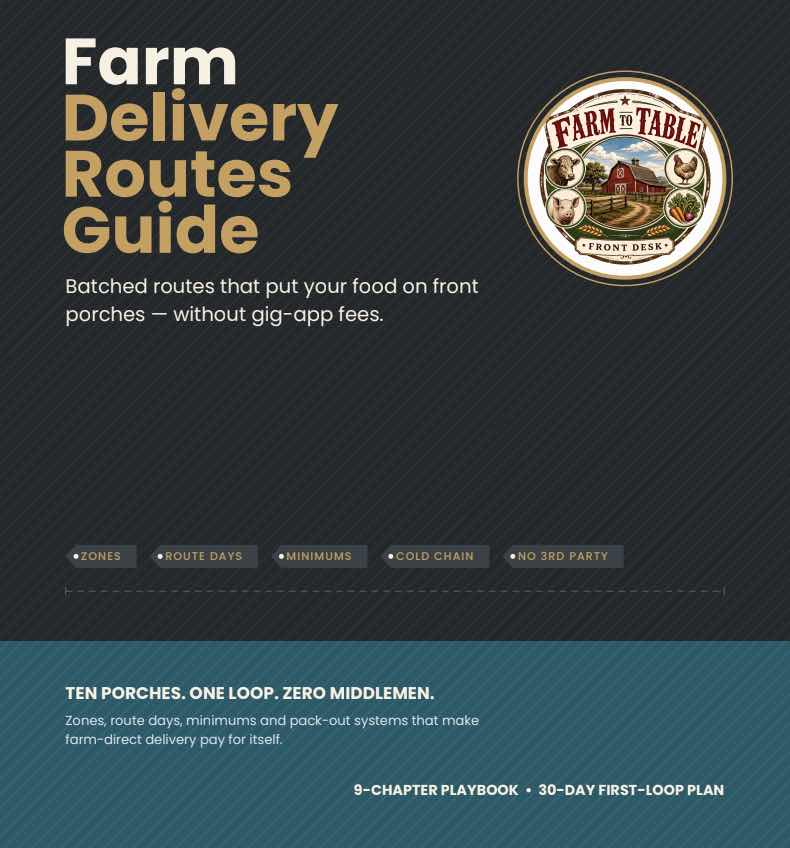
Farm Delivery Routes Guide
Farm Delivery Routes Guide
Couldn't load pickup availability
Build Farm Delivery Routes That Actually Pay for Themselves
Ten porches, one loop, zero middlemen. The Farm Delivery Routes Guide gives you a proven system for turning scattered, money-losing drop-offs into scheduled neighborhood loops that make farm-direct delivery profitable.
Most farms lose money on delivery by driving one-off trips or handing margin to gig apps. This guide replaces that with batched routes: group orders by zone, set fixed route days, and maximize stops per mile.
The formula is simple — Batch → Loop → Drop.
How the Farm Delivery Routes System Works
Instead of paying third-party commissions or eating the cost of individual deliveries, you build an efficient direct-to-consumer delivery system that pays for itself.
You'll design delivery zones, set order minimums and honest delivery fees, keep cold-chain compliance intact, and grow customer density so every route earns its keep.
What You'll Learn
- Design profitable delivery zones — drawn by drive time, each with its own route day, minimum, and fee
- Optimize your routes — sequence stops to avoid backtracking and raise stops per mile
- Price delivery correctly — flat fees, zone pricing, free-delivery thresholds, and route passes
- Run a clean pack-out — cold-chain handling, reverse load order, and a printed manifest
- Fill routes without driving farther — density first, using standing orders and neighborhood ambassadors
- Build recurring revenue — weekly and biweekly subscriptions that stabilize every loop
What's Inside the Guide
The Route Order
- Chapter 1 — Why Run Your Own Routes: front-door service without the app fees
- Chapter 2 — Loop Economics: why batching turns miles into margin
- Chapter 3 — Design Your Zones: drive-time maps, route days and floors
- Chapter 4 — The Route Rules: five habits that keep loops profitable
- Chapter 5 — Pack-Out & the Van: cold chain, load order and the manifest
- Chapter 6 — Pricing Delivery: fees, minimums and route passes
- Chapter 7 — Fill the Route: density first — stops per mile is the game
- Chapter 8 — Delivery-Day Pitfalls: the five ways loops lose money
- Chapter 9 — Measure & Scale: per-loop numbers and the second route
- 30-Day First-Loop Plan: your week-by-week checklist
How to use this guide: Chapters 1–3 design a loop that can pay for itself before you drive a mile. Chapters 4–6 run it, 7–9 fill and grow it, and the 30-day plan takes you from map to first completed route.
Frequently Asked Questions
What is the best way to build profitable farm delivery routes?
Replace one-off deliveries with scheduled delivery loops that batch orders by neighborhood, assign fixed delivery days, and maximize stops per mile. This approach lowers delivery costs while improving customer convenience and profitability.
How can farms create a profitable local delivery system?
Profitable farm delivery rests on four fundamentals: delivery zones, fixed route days, order minimums, and delivery fees that cover operating costs. Instead of charging too little or offering unlimited delivery, farms build predictable delivery loops that pay for themselves.
What is a farm delivery loop?
A farm delivery loop is a scheduled route where orders are grouped by delivery zone, packed together, and delivered in one efficient circular route rather than individual trips throughout the week. The guide summarizes the process as Batch, Loop, Drop.
How do I optimize farm delivery routes?
Organize routes around drive time rather than mileage, assign one delivery day per zone, sequence stops to avoid backtracking, and increase customer density before expanding into new areas. These steps cut driving time while keeping routes full.
What is farm route optimization?
Farm route optimization means designing delivery routes that maximize paying stops while minimizing unnecessary driving. According to the guide, "stops per mile" is the most important profitability metric.
How do delivery zones improve farm profitability?
Delivery zones create predictable service areas where orders are grouped together on scheduled days. Each zone should have its own delivery fee, order minimum, and fixed delivery schedule to keep routes profitable.
How should farms plan delivery routes?
Draw zones by drive time, assign one delivery day per zone, create delivery minimums, publish delivery maps, and expand only after neighborhoods reach enough customer density. This lets delivery grow without unnecessarily increasing operating costs.
How can local farms compete with delivery apps?
Build your own branded delivery routes instead of paying commissions to third-party platforms. This creates direct customer relationships and eliminates marketplace fees.
What is scheduled farm delivery?
Scheduled farm delivery uses recurring route days rather than on-demand deliveries. Customers order before a cutoff time and receive deliveries on the same weekday each week, making operations easier to manage and more profitable.
How do recurring farm deliveries work?
Recurring deliveries run on weekly or biweekly standing orders and subscriptions. These customers increase delivery density, improve forecasting, and make each route more profitable over time.
Should farms offer free delivery?
No. Free delivery often hides transportation costs inside product pricing and encourages small, unprofitable orders. Instead, use transparent delivery fees and reasonable order minimums.
How do farms price local delivery?
Common pricing models include flat delivery fees, zone-based pricing, free-delivery thresholds, monthly delivery passes, and neighborhood pickup hosts. Each model is matched to different customer and geographic situations.
What is cold chain delivery?
Cold chain delivery keeps refrigerated and frozen foods at safe temperatures throughout transport. The guide recommends insulated containers, ice packs, thermometers, and organized pack-out procedures to maintain food quality from farm to porch.
What is porch delivery?
Porch delivery lets customers receive farm orders without a face-to-face appointment. Labeled deliveries with photo confirmation speed up routes while improving customer communication.
How should farms organize delivery day?
Pack orders by stop, load the vehicle in reverse stop order, print a delivery manifest, use optimized routing, and follow standardized delivery procedures. These practices reduce delivery time and improve consistency.
How can farms grow local delivery without driving farther?
Increase customer density inside existing delivery zones before opening new ones. Existing pickup customers, neighborhood ambassadors, and waiting lists all help fill routes while minimizing additional driving.
What is the best delivery route planner for farms?
Rather than a specific software product, the guide focuses on practical route-planning principles: delivery zones, fixed route days, stop sequencing, route density, and standardized delivery policies. Master these and most route planners will work.
How do subscriptions improve farm delivery?
Recurring subscriptions provide predictable weekly or biweekly deliveries that improve route density and revenue stability. Standing orders become the foundation of profitable delivery loops.
How should farms measure delivery performance?
Track stops per route, total miles, hours worked, product revenue, and delivery fees collected. These metrics help farms improve efficiency and determine when to expand into additional routes.
Does this guide include a farm delivery implementation plan?
Yes. The guide concludes with a practical 30-day implementation plan covering delivery zone creation, pricing, equipment, pilot routes, subscriptions, neighborhood recruitment, and ongoing optimization to help farms launch their first profitable delivery loop.
Pairs with