Farm To Table Front Desk Growth Guides
Best Ecommerce Platform for Farms Guide
Best Ecommerce Platform for Farms Guide
Couldn't load pickup availability
Find the Right Ecommerce Platform for Your Farm — Before You Spend a Dime
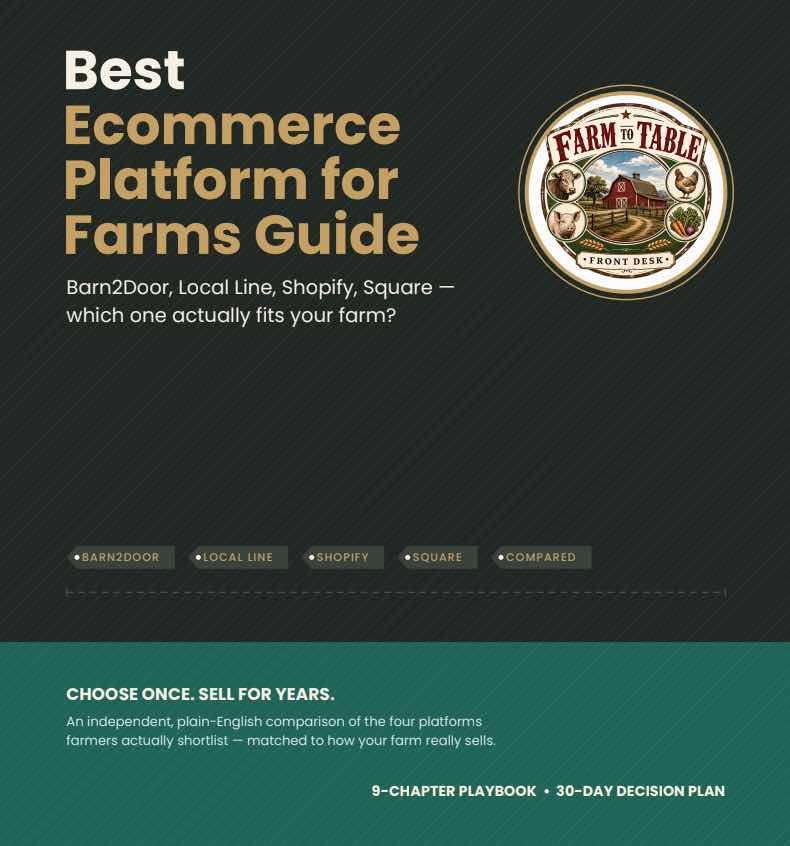
Barn2Door, Local Line, Shopify, Square — which one actually fits your farm? The Best Ecommerce Platform for Farms Guide is an independent comparison that matches each platform to how your farm really sells, so you choose right the first time.
There's no single "best" platform for every farm. The best one is the one that fits your workflows — CSA boxes, wholesale accounts, farmers markets, delivery routes, or nationwide shipping.
Instead of ranking software by popularity, this guide maps it to real farm business models.
How This Farm Ecommerce Comparison Works
Most platform reviews compare feature checklists. This guide compares the workflows that actually make or break a farm sale — catch-weight pricing, subscriptions, pickup and delivery scheduling, wholesale price lists, and unified inventory.
You get a practical framework to evaluate features, calculate true cost of ownership, dodge the common purchasing mistakes, and commit with confidence.
What You'll Get
- Head-to-head platform profiles — Barn2Door, Local Line, Shopify, and Square compared side by side
- Match your farm to a lane — direct-to-consumer, wholesale, or market-first, each pointed to the right fit
- The five features that matter most — catch-weight pricing, CSA subscriptions, scheduling, wholesale pricing, inventory sync
- True cost of ownership math — subscription fees, payment processing, apps, and your admin hours
- A setup path that avoids stalls — from signup to your first real order
- A one-week decision process — shortlist, trial with your real products, commit
What's Inside the Guide
The Stack Order
- 01 — Why the Platform Matters: farm selling breaks normal e-commerce
- 02 — The Four Contenders: profiles, then the head-to-head table
- 03 — Match Platform to Farm: three farm types, three clear lanes
- 04 — The Features That Matter: five make-or-break capabilities
- 05 — True Cost of Ownership: subscription, fees, apps — and your hours
- 06 — Setup Without the Stall: from signup to first real order
- 07 — The Rest of the Stack: payments, messaging, books and labels
- 08 — Decision Pitfalls: five ways farms pick wrong
- 09 — Decide in One Week: shortlist, trial, commit — done
- 30-Day Decision Plan: your week-by-week checklist
How to use this guide: Chapters 1–2 give you the landscape and the head-to-head. Chapter 3 points at your lane, 4–5 pressure-test it, 6–8 get you live without regret, and the 30-day plan runs the whole decision on a calendar.
Frequently Asked Questions
What is the best ecommerce platform for farms?
There is no single "best" platform for every farm — the best one matches how your farm actually sells. The guide matches platforms to real workflows including farmers markets, CSA programs, wholesale accounts, subscriptions, and nationwide shipping.
How do I choose the best ecommerce platform for my farm?
Start by identifying how you sell, then evaluate five make-or-break workflows, compare total cost of ownership, and test your real products before committing. This structured process helps you choose based on fit rather than hype.
Barn2Door vs Local Line: which is better?
Both are farm-first ecommerce platforms, but they serve slightly different needs. Barn2Door emphasizes guided onboarding, subscriptions, and delivery routes, while Local Line stands out for wholesale price lists, retail sales, and food hub customers.
Is Barn2Door good for farms?
Yes — Barn2Door is built specifically for direct-to-consumer farms, with subscriptions, CSA boxes, delivery routes, catch-weight support, and coaching. Farms should also weigh its setup costs and all-in approach.
Is Local Line a good ecommerce platform for farms?
Yes, especially for farms selling to households, restaurants, grocery stores, and food hubs. Local Line supports multiple customer price lists from one catalog, which makes mixed retail and wholesale selling easier.
Is Shopify good for farms?
Shopify offers exceptional flexibility, design options, and an extensive app ecosystem. Keep in mind that many farm-specific workflows require additional apps and setup compared with dedicated farm platforms.
Is Square good for farms?
Square is a strong fit for farms centered on farmers markets and in-person sales. It combines a point-of-sale system with a simple online store using one catalog and one payment system.
Which ecommerce platform is best for CSA farms?
Barn2Door and Local Line were both built with CSA subscriptions and recurring farm boxes in mind. The guide recommends testing subscription workflows with your own products before deciding.
Which platform is best for wholesale farm sales?
Farms serving chefs, restaurants, grocery stores, and food hubs should choose platforms that support buyer-specific pricing and wholesale order management. Local Line is highlighted for these capabilities.
Which ecommerce platform works best for farmers markets?
Farms focused primarily on in-person selling benefit most from a POS-first platform that connects booth sales and online ordering within one system. This keeps inventory and reporting consistent across channels.
What is catch weight ecommerce?
Catch-weight ecommerce lets products sold by weight display an estimated checkout price, then automatically adjust after the final packed weight is recorded. It's one of the most important features for meat farms and other weight-priced products.
What is sell-by-weight software?
Sell-by-weight software supports products priced per pound by estimating costs during checkout and updating invoices once products are weighed. The guide recommends testing this workflow with your actual products before choosing a platform.
What should farm inventory software do?
Farm inventory software should synchronize online orders, wholesale accounts, and farmers market sales in one system so inventory stays accurate across every sales channel. A unified system prevents overselling and manual reconciliation.
Can I manage subscriptions and recurring farm boxes?
Yes. The guide compares how platforms handle recurring subscriptions, CSA shares, monthly meat boxes, and standing orders, and recommends testing pausing, skipping, and swapping before deciding.
Can I use Shopify or Square together?
Yes — many farms use Square for in-person sales while running a farm-focused ecommerce platform online. Just avoid maintaining duplicate catalogs, inventory systems, and customer databases whenever possible.
What is the true cost of farm ecommerce software?
True cost includes four things: subscription fees, payment processing fees, apps and add-ons, and administrative time. The guide also encourages farms to factor in switching costs before changing platforms.
What features matter most in farm ecommerce software?
Five workflows matter most: catch-weight pricing, pickup and delivery scheduling, CSA subscriptions, wholesale price lists, and unified inventory management. Test each one with your real products before purchasing software.
What is the best farm POS system?
Farms that primarily sell at markets should evaluate POS-first systems that combine in-person and online sales in one catalog. This keeps inventory and reporting consistent across booth and online sales.
How do I compare ecommerce platforms for my farm?
Use a one-week decision process: shortlist two platforms, load your real products, test your actual pickup and delivery workflow, compare pricing using your real monthly sales, then commit and launch with a structured 30-day plan.
Does this guide include a farm ecommerce implementation plan?
Yes. The guide concludes with a practical 30-day decision and launch checklist covering platform selection, testing, pricing evaluation, setup, customer migration, and store launch.